

Brainwaves: Brain to Brain Broadcasting
Have you ever felt you were on the same wavelength with someone? We dismiss these moments as coincidence. Or chemistry. Or intimacy. But what if they are something else entirely?

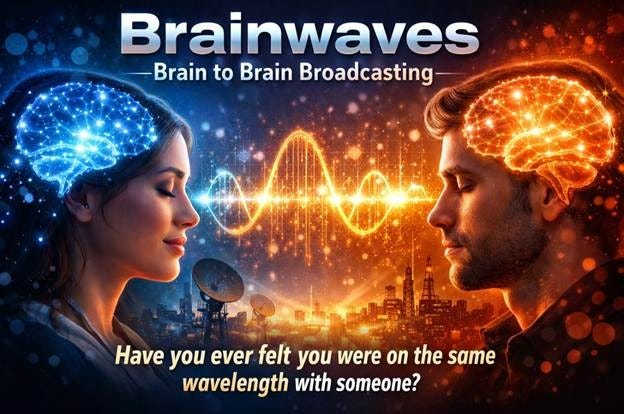
Have you ever felt you were on the same wavelength with someone? Not metaphorically. Not as a figure of speech. But as a lived, almost physical experience. The moment when a thought forms in your mind and, before it fully settles, someone else speaks it aloud. The call you receive from the person you were just about to dial. The shared glance that carries more information than language could ever hold.
We dismiss these moments as coincidence. Or chemistry. Or intimacy. But what if they are something else entirely?
When the world goes quiet, I hear a faint electronic buzzing. You probably do too, if you listen closely enough. It sits just at the edge of perception. Easy to ignore. Easier to rationalize. We tell ourselves it is internal. Neural noise. The hum of biology.
But I have spent a lifetime asking a different question. What if it is not just in our heads? What if it is the sound of a world saturated with signal?
I go back to my teenage years in the 1960s, hunched over manuals, studying for my FCC Third Class Radiotelephone License. I was not chasing credentials. I was chasing access. I wanted to be a radio disc jockey, yes, but more than that, I wanted to understand the invisible. I had saved for and built a crystal radio set when I was nine years-old, stringing the antenna out my window to capture distant radio signals and listen to rock ‘n roll.
How could voices and music travel through the air without wires? How could music leave a transmitter miles away and arrive, intact, into my crystal radio or in the palm of my hand through a transistor radio?
Radio waves felt like magic. But they were not magic. They were physics. Frequencies, modulation, transmission, reception. A language the universe already understood. And I remember thinking, with the unfiltered curiosity of a teenager: if we can broadcast signals through the air, why can’t our brains do the same thing?
At the time, the question felt like science fiction. Today, it feels like early-stage engineering.
We now know that the brain is not silent. It is an electrical organ. Neurons communicate through electrochemical signals that produce measurable oscillations. Brainwaves. Frequencies. Patterns that can be detected, interpreted, and increasingly, decoded.
Technologies such as electroencephalography, or EEG, have allowed us to read these signals for decades. More recently, functional MRI has mapped the brain in action, correlating thought and intention with specific neural activity. This is not speculative. It is empirical.
Even more striking is what has emerged in the past decade. Brain-computer interfaces, once confined to research labs, are moving into clinical and commercial reality. Companies like Neuralink and Synchron are developing implantable devices that translate neural signals into digital commands. Patients who have lost the ability to move can now control cursors, type messages, and interact with machines using only their thoughts.
The direction of communication is no longer one-way.
Scientists have already demonstrated rudimentary brain-to-brain communication. In controlled experiments, one subject’s brain signals are captured, processed, and transmitted to another subject’s brain, influencing motor responses or perceptual experiences. No spoken words. No physical gestures. Just signal to signal.
This is not telepathy in the mystical sense. It is telepathy in its earliest technological form.
The implications are profound.
If a brain can transmit a signal that a computer can interpret, and that computer can transmit a signal that another brain can receive, then we are already standing at the threshold of brain-to-brain broadcasting. Not metaphorically. Literally.
Which brings us back to that quiet buzzing.
The electromagnetic spectrum that surrounds us is dense with information. Radio, television, cellular networks, Wi-Fi, satellite communications. We live inside a constant field of transmission. Our devices are designed to tune into specific frequencies and decode specific signals.
The human brain, by contrast, is both more powerful and more limited. More powerful in its capacity for meaning, abstraction, and emotional depth. More limited in its ability to consciously tune, filter, and transmit across distance. But limitations in biology have never been permanent. They have been temporary constraints, eventually expanded by tools, systems, and learning.
So the question is no longer whether brain-to-brain communication is possible. The question is how it will evolve.
Will it be mass communication, where signals are broadcast broadly, like radio once was? Or will it be directed, one-to-one, secure and intentional, like a private conversation? Will it be controllable, with clear boundaries and permissions, or will it introduce new vulnerabilities that we have yet to fully understand? There are early signals pointing in all directions.
Non-invasive technologies are improving rapidly, allowing for increasingly precise decoding of brain activity without surgery. At the same time, invasive interfaces offer higher fidelity and faster transmission, raising both possibility and ethical complexity.
Artificial intelligence is accelerating this trajectory. Machine learning models are becoming more adept at interpreting neural data, translating patterns into language, images, and commands. In some experiments, researchers have reconstructed rough images and sentences directly from brain activity.
The brain is becoming readable. The next step is making it writable. And this is where the convergence becomes unmistakable.
If machines can communicate with each other at near-instantaneous speeds, exchanging vast amounts of data across networks, there is no fundamental reason the human brain cannot learn to participate in that network. Whether through augmentation, adaptation, or co-evolution, the direction is clear.
This is not about replacing human communication. It is about expanding it. Which is the central premise of Your Third Brain: Powering a Future of Unimagined Possibilities, my forthcoming book. The Third Brain is not a device. It is a system. A dynamic integration of biological intelligence, social intelligence, and machine intelligence.
Brain-to-brain broadcasting sits at the intersection of all three. Biological intelligence generates the signal. Social intelligence gives it meaning and context. Machine intelligence enables its amplification, transmission, and translation.
Together, they create a new layer of connectivity that moves beyond language into shared cognition.
This is where my journey, which began with a teenage fascination with radio waves, converges with a much larger arc.
In my forthcoming Eidolon science fiction trilogy, I explore a concept called the Current. It is a universal communication force that connects consciousness across time and space. It is fiction, but it is grounded in a simple idea. That communication is not limited to what we can currently measure or control.
What we once called invisible is now infrastructure. What we once called impossible is now in prototype. And what we now call coincidence may, in time, be understood as early evidence of a deeper connectivity.
There is a tendency to approach these ideas with either skepticism or hype. Both miss the point. The real work is in understanding the trajectory and shaping its direction.
Because brain-to-brain broadcasting is not just a technological milestone. It is a human one.
It raises questions about privacy, identity, empathy, and trust. If thoughts can be shared directly, what happens to misunderstanding? If emotions can be transmitted, what happens to isolation? If knowledge can move without language, what happens to learning?
And perhaps most importantly, who controls the signal? These are not future questions. They are present-tense design challenges. The leaders, technologists, and thinkers shaping this space today are not just building tools. They are defining the architecture of human connection for generations to come.
Which brings me back, once again, to that original question. Have you ever felt you were on the same wavelength with someone?
Maybe that feeling is not accidental. Maybe it is not just emotional resonance or shared experience. Maybe it is the earliest, most human expression of something we are only beginning to understand.
A signal. A connection. A moment of alignment across two minds.
Not yet measurable. Not yet controllable. But undeniably real.
The future of communication will not begin with machines.
It will begin with moments like that.
And then, quietly at first, it will scale.
For those who believe and are committed to different questions and new answers, support The Myers Report Substack; the Lead Human with Jack Myers & Tim Spengler podcast; my books available at all booksellers (www.jackmyersbooks.com). It’s not only about your financial support. It is about validation.
Jack- Great column! When we next talk I will share some thoughts with you . Obviously I have given this a lot of thought.