

Scroll to the bottom of this article for exclusive subscriber-only content.
For more than a century the advertising industry operated within a relatively stable power structure.
Brands defined the objectives.
Agencies developed strategy and creative ideas.
Media companies controlled distribution.
The system was imperfect but understandable. Power flowed through relationships, human judgment, and negotiated influence.
Artificial intelligence is quietly dismantling that structure.
The next generation of advertising may not be controlled primarily by agencies, brands, or media companies. It may increasingly be controlled by the platforms that build and operate the intelligence systems through which advertising decisions are made.
This shift is not dramatic or theatrical. It is gradual, technical, and largely invisible. But it is redefining where power sits inside the advertising economy. And most leaders in the industry are still thinking about the future as if the old structure remains intact.
It does not. Here’s why and how.
The Hidden Shift in Advertising Power
Over the past fifteen years three forces have steadily restructured how advertising works.
First came algorithmic media buying.
Programmatic technology moved media allocation away from manual negotiation and toward automated optimization. Today a large portion of digital advertising investment flows through systems that make allocation decisions in milliseconds.
Second came platform dominance.
Digital ecosystems such as Google, Meta, Amazon, TikTok, and others increasingly control the environments where audiences spend their time. These platforms also control the data and measurement systems that define campaign performance.
Third came machine learning optimization.
Accelerated Artificial intelligence systems now influence nearly every stage of the marketing process. They analyze audience behavior, generate creative variations, optimize targeting, allocate budgets, and measure outcomes.
Individually these developments appear evolutionary. Together they create something far more profound. Advertising is becoming a machine-mediated decision system.
When the Machine Becomes the Marketing Funnel
The traditional marketing funnel was built around human decision making.
Strategists defined the target audience.
Creative teams developed messaging.
Media buyers placed advertising.
Analysts measured performance.
Artificial intelligence collapses these stages into a single integrated system.
The machine can identify audiences, generate creative variations, distribute those messages across multiple channels, measure the results, and continuously refine the process in real time.
The system learns as it operates. Over time the machine does not simply support the marketing funnel. It becomes the funnel.
When this happens the location of strategic control shifts. It moves away from the people operating campaigns and toward the systems that shape how decisions are made.
That is the quiet structural transformation now unfolding across advertising.
The Platformization of Advertising
The largest beneficiaries of this transformation are not agencies. They are platforms.
The companies building the artificial intelligence infrastructure that powers advertising increasingly control the critical elements of the marketing system.
They control audience data.
They control optimization algorithms.
They control distribution channels.
They control measurement frameworks.
This concentration of capabilities creates a powerful advantage.
When the same platform manages audience data, advertising delivery, performance measurement, and optimization algorithms, it effectively governs the entire decision loop.
In the past, agencies and brands made most strategic decisions and platforms executed them. Today platforms increasingly shape the decisions themselves. This is not a conspiracy or a deliberate takeover. It is simply the natural outcome of technological architecture. When intelligence systems sit at the center of the advertising ecosystem, the organizations that design those systems inevitably accumulate influence.
The industry is moving toward a model in which advertising decisions are increasingly made within platform ecosystems rather than by independent industry players.
The Strategic Crisis for Agencies
For decades agencies occupied a privileged position within the advertising value chain.
They owned three core sources of influence.
Creative thinking.
Strategic planning.
Media expertise.
Artificial intelligence now touches all three.
AI systems can generate creative variations at massive scale.
They can analyze audience behavior with extraordinary precision.
They can optimize media allocation faster than any human team.
None of this means agencies become irrelevant.
But it does mean the nature of agency value must evolve.
Agencies that position themselves primarily as operators of marketing machinery will find themselves competing with the machinery itself.
The agencies that thrive will be those that focus on capabilities machines cannot easily replicate.
Cultural interpretation.
Human storytelling.
Emotional intelligence.
Strategic discernment.
Machines can analyze data. They struggle to understand meaning.
The agencies that recognize this distinction will remain indispensable partners to brands. Those that do not risk becoming operational intermediaries inside systems controlled by others.
The Strategic Crisis for Media Companies
Media companies face an equally profound challenge. Historically they controlled access to audiences. Their business models were built around scarcity. If brands wanted to reach large audiences, they needed media partners.
Artificial intelligence and digital platforms have reshaped that dynamic.
Discovery increasingly happens through algorithms.
Audience targeting happens through data systems.
Distribution is mediated through platform ecosystems.
As a result, many media companies now operate within environments where the mechanisms that deliver audiences are controlled elsewhere.
This does not eliminate the value of great storytelling or compelling content. But it does mean the economic structure surrounding that content is evolving. The organizations that control the intelligence layer of media distribution increasingly shape which content is seen and which advertising reaches audiences.
In other words, control of the audience experience is shifting away from traditional media institutions and toward the systems that manage discovery and distribution.
That shift has enormous implications for the future economics of media.
The Companies That Control the Platforms
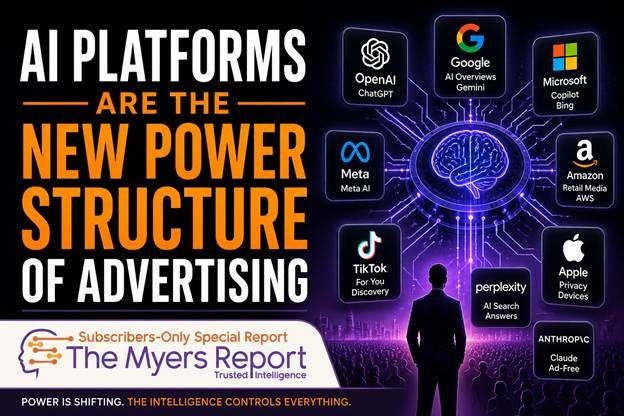
To understand where advertising power is moving, it helps to identify the companies that increasingly control the platforms through which marketing decisions are made.
The Companies That Control Advertising’s Intelligence Layer
To understand where advertising power is moving, the industry needs to look beyond media companies and even beyond the traditional digital platforms.
The next power center is the intelligence layer.
Alphabet remains foundational through Google Search, YouTube, Android, AI Overviews, AI Mode, Gemini, and its advertising technology stack. Its advantage is not simply scale. It is the ability to connect search intent, video attention, cloud infrastructure, commerce signals, and AI-generated discovery into one advertising ecosystem.
Meta remains one of the most powerful advertising companies in the world through Facebook, Instagram, WhatsApp, Threads, Reels, and its rapidly expanding Meta AI ecosystem. Its strategic move is especially important: Meta is beginning to use interactions with its AI assistant to personalize content and advertising across its apps. That means AI conversation becomes not only a user experience, but an advertising signal.
Amazon controls the commerce layer. Its advantage is proximity to transaction. As retail media continues to expand, Amazon is positioned to connect advertising, product discovery, streaming, marketplace behavior, and purchase data in ways few companies can match.
Apple controls the device and privacy layer. It does not yet operate at Google or Meta scale in advertising, but it governs access, consent, identity, app distribution, and mobile measurement. In an AI-mediated advertising economy, control over the operating system becomes a form of market power.
ByteDance and a consortium of corporate interests control one of the most influential discovery engines in global media. TikTok’s algorithm has already reshaped culture, entertainment, shopping, music, and brand communication. Its power is not only audience reach. It is cultural acceleration.
OpenAI now belongs in this group. ChatGPT is becoming a new advertising environment built around conversation, intent, advice, decision support, and task completion. This is different from search advertising. It is not merely about bidding on keywords. It is about appearing inside the moment when a person is asking for help, narrowing choices, planning action, or preparing to buy. OpenAI’s early ad principles emphasize trust, answer independence, privacy, and user control, but the strategic implication is clear: ChatGPT can become a direct-to-advertiser and direct-to-agency platform that competes for budgets historically assigned to search, social, retail media, affiliate, lead generation, and eventually commerce conversion.
Microsoft should also be included. Through Bing, Copilot, LinkedIn, Microsoft Advertising, and enterprise workflow integration, Microsoft is building advertising opportunities inside AI-assisted search, productivity, and decision environments. Its position is especially important for B2B, professional services, enterprise software, and high-consideration purchase categories.
Perplexity represents the early stress test for AI-native advertising. Its sponsored-answer experiment revealed the central tension in this market: the more intimate and trusted the AI experience becomes, the more dangerous poorly designed advertising can be. In traditional search, users expect commercial influence. In AI assistance, users expect help. That distinction may define the economics of the next decade.
Anthropic represents the counter-position. Claude’s ad-free stance is not a rejection of monetization. It is a strategic bet that trust, subscription revenue, enterprise adoption, and institutional credibility may be more valuable than advertising yield. This makes Anthropic important not because it controls advertising, but because it challenges whether every AI assistant must become an advertising platform.
Together, these companies are redefining advertising control.
The old question was: Who owns the audience? The new question is: Who owns the decision environment?
That is the structural shift. Advertising is no longer moving only through media channels. It is moving through intelligence systems. The companies that control those systems will increasingly control discovery, recommendation, measurement, optimization, and conversion.
This is why the advertising industry’s next competitive battlefield is not media buying. It is not creative automation. It is not even data.
It is trust inside the intelligence layer.
What comes next is where this shift becomes uncomfortable.
In the subscriber section that follows, I break down what this power transfer actually means for agency holding companies, media organizations, and brand leaders. Who loses leverage. Who gains it. And what strategic moves are already emerging beneath the surface that most of the industry has not yet fully processed. If you are responsible for growth, revenue, or competitive positioning, this is not theoretical. It is operational.
Continue reading with a Myers Report subscription for $40 annually or $12 monthly. Corporate group subscriptions are available at a 30% discount for teams navigating this transition together.