

The Intelligence Paradox: Knowing Less, Understanding More
“Not knowing is the beginning of knowing.” Lao Tzu

Excerpted from my next book Your Third Brain: Powering a Future of Unimagined Possibilities (Morgan James August 2026). Advance purchase will soon be available.
We are drowning in information. And starving for wisdom.
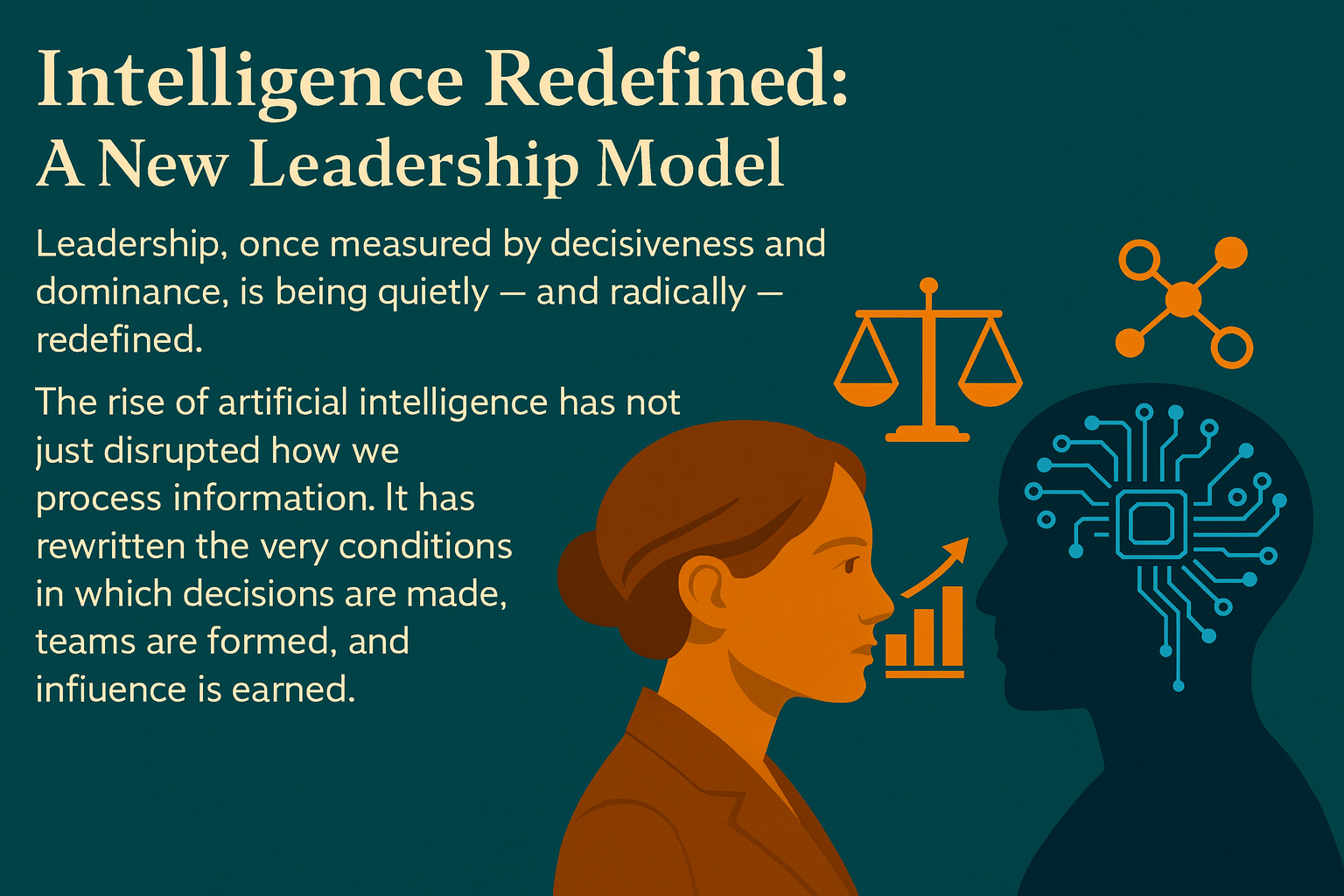
In this paradox lies a truth that most leaders, educators, and even technologists are just beginning to confront. Intelligence is no longer defined by what you know. It’s defined by how you learn. For centuries, intelligence was synonymous with mastery. With certainty. With being the one in the room who had the answer before the question was finished. Degrees, credentials, titles all signaled authority rooted in accumulation. The more you knew, the more valuable you became.
But today, that logic is collapsing. The smartest person in the room may now be the one who pauses. Who says, “I don’t know but I’m listening.” Who asks the better question, rather than rushing to the first solution. Who recognizes that the map has changed, and with it, the terrain of knowing. We live in an age where information is abundant, immediate, and always
updating. Infinite knowledge is available with a prompt. But this abundance creates a new burden: the burden of discernment.
What’s real? What’s relevant? What’s worth trusting? These are no longer questions of access. They are questions of presence.
“Not knowing is the beginning of knowing.” Lao Tzu
This principle, drawn from Taoist tradition, is not a rejection of knowledge. It is an invitation to become intimate with unknowing. To walk with ambiguity, not away from it. To sit in uncertainty long enough to let emergence take shape. In The Tao of Leadership in the AI Era, I wrote that true power lies in emptying, not accumulation. A full cup cannot receive. A full mind cannot adapt. Leaders who cultivate stillness, who invite silence into decision-making, who hold the pause between input and action, are not slow. They are wise.
We are at a cultural crossroads. On one side: the Western obsession with certainty, performance, mastery. The desire to name, to solve, to conquer complexity. On the other: an Eastern reverence for process, for paradox, for the beauty of the incomplete. AI is pulling us toward the former—faster answers, optimized certainty, algorithmic confidence. But leadership must reach for the latter, not as resistance but as balance.
Because intelligence is no longer a race to the answer. It is a relationship with uncertainty. It is the cultivation of stillness in a storm of signals. It is the choice to remain open, when every system around you is rushing to close the loop. We used to admire those who always knew. Now, we must learn to follow those who are brave enough to not know—yet.
Purchase your copy of The Tao of Leadership in the AI Era from your preferred book seller. I recommend Barnes & Noble and your local bookstore. In the meantime, support my work, my commitment to human energy and creativity, and my guidelines for leadership in the AI era by subscribing to The Myers Report Substack. Your support is not only financial, its emotional and meaningful.