

Three Deficits in Organizational Judgment. Crisis Management for the Human Soul: Part III
There is a confusion about AI and decision-making that is worth clearing up. The confusion is between analysis and judgment. AI is excellent at one of them and incapable of the other.

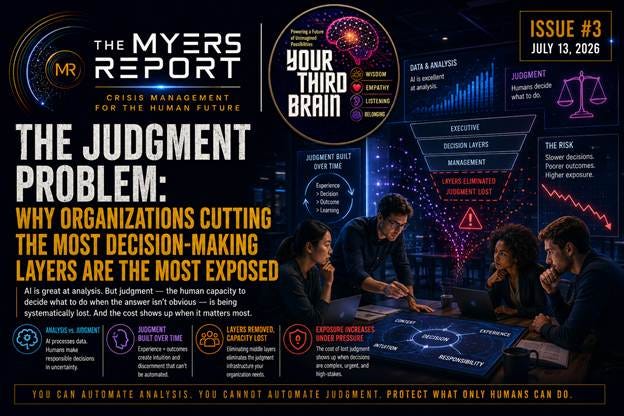
Welcome to The Myers Report Crisis Management for the Human Soul Part III. I’ll start with a conversation I had recently with the chief revenue officer of a major media company. We were talking about the reorganization his company had just completed. It was a significant reduction in middle management justified partly by AI-assisted workflow automation, partly by margin pressure, partly by the logic that had become almost universal in the sector over the past two years. The layers between the executive suite and the front line had become redundant, information now moved fast enough, and tools were now smart enough that the human intermediaries were a cost center rather than a value center.
He was candid. The reorganization had gone largely as planned. The efficiency metrics looked good. Cycle times were down. Headcount costs were down. The AI tools were performing as advertised.
Then I asked him a question I have been asking a lot of senior leaders lately. I asked him what happened the last time a client required a fast, high-stakes decision in conditions of genuine uncertainty; the kind of decision where the data was incomplete, the precedents were ambiguous, and the right answer was not going to reveal itself through AI analysis alone.
He was quiet for a moment. Then he said: we did not have the internal knowledge to judge our options or confidence in our decisions. And I am not sure we understand why.
I understand why. And it is not the AI tools.
Three Failure Deficits in Organizational Judgment
Based on what I have observed across client organizations and advisory conversations over the past three years, the judgment deficit manifests in three specific and recurring failure modes. Naming them precisely is the first step toward diagnosing whether your organization is carrying any of them.
JUDGMENT DEFICIT #1: The Analysis Loop
This is the organizational behavior of returning repeatedly to data and modeling when a decision is not resolving, not because the data is genuinely insufficient, but because the human capacity to make a judgment call in the absence of certainty has been so systematically devalued that nobody in the room feels authorized to do it. Organizations in an analysis loop produce excellent decks and postponed decisions. They are particularly vulnerable at exactly the moments when speed matters most, which is to say, in conditions of genuine competitive disruption.
JUDGMENT DEFICIT #2: Precedent Dependency
This is the organizational tendency to treat every decision as a variant of a known pattern, because the judgment capacity required to recognize genuine novelty has been compressed out of the decision-making structure. Organizations with severe precedent dependency are operationally capable and strategically blind. They execute well against the last disruption and arrive late to the next one. In a sector where the competitive landscape is shifting as rapidly as advertising-supported media, this is not a modest liability. It is an existential one.
JUDGMENT DEFICIT #3: Authority Diffusion
This is the organizational condition in which nobody is clearly responsible for a judgment call because the decision-making architecture has been flattened, automated, or distributed to the point where the locus of accountability is genuinely unclear. Authority diffusion is often invisible from the inside. It feels like consensus culture or collaborative process but it produces a characteristic outcome. Decisions are made by default rather than by choice, because the conditions under which a clear judgment call would be required are never quite allowed to arrive. Organizations with authority diffusion do not make bad decisions. They make slow, hedged, half-decisions, and they lose ground to competitors willing to commit.
What Healthy Judgment Infrastructure Actually Looks Like
I am not arguing for the restoration of bloated management structures or the rejection of AI-assisted decision support. I am arguing for something more specific: a deliberate, conscious investment in the human judgment capacity that AI cannot supply, maintained in clear organizational distinction from the analytical capacity that AI can supply very well.
In practical terms, this means a few things.
It means protecting and investing in the senior people who carry the deepest and most varied stores of institutional knowledge, even when — especially when — an efficiency argument cannot be made for their roles. The efficiency argument is almost always technically correct. It is almost always strategically incomplete. The judgment these people carry is an asset on no balance sheet, which means it is invisible to every cost-reduction analysis. That invisibility is not evidence that the asset does not exist. It is evidence that the analysis is missing something important.
It means creating explicit structures for judgment-bearing conversation, the kind of conversation where a senior leader can say “I do not trust this analysis” without having to prove the distrust through counter-analysis. Where pattern recognition built over decades can be surfaced and tested against current conditions. Where the people with the most relevant experience are not simply briefed on decisions already made but genuinely consulted before the direction is set.
It means developing what I have come to think of as judgment literacy at the leadership level: the capacity to distinguish between the decisions that AI tools can appropriately support and the decisions that require human judgment to bear. To be explicit in real time with the team about which kind of decision is currently being made. Most organizations conflate these constantly. The ones building genuine judgment infrastructure are learning to separate them cleanly.
And it means accepting, at the most senior level, that the quality of organizational judgment — and accountability — is a strategic variable that requires active management. Not as a human resources concern or a cultural initiative but as a core component of competitive positioning in a market where the organizations that can think well under uncertainty will have sustainable advantages over those that cannot.
What judgment actually is.
There is a persistent confusion in most organizational conversations about AI and decision-making, and it is worth clearing up before going further. The confusion is between analysis and judgment, and it matters enormously because AI is genuinely excellent at one of them and constitutionally incapable of the other.
Analysis is the work of processing available information, identifying patterns, modeling scenarios, and producing outputs that reduce uncertainty. It is the work of knowing what the data says. AI performs this work faster, cheaper, and at greater scale than any human being or human team. This is not a qualified statement. It is simply true, and organizations that have not yet accepted it are making decisions that will look inexplicable in five years.
Judgment is something different. Judgment is the work of deciding what to do when the analysis is complete but the decision is not obvious. It is the capacity to weigh incommensurable things. Commercial interest against relational trust, short-term certainty against long-term positioning, what the numbers say against what the room knows that the numbers do not. It is the ability to recognize when a situation is genuinely novel rather than a variant of a known pattern, and to act in the absence of reliable precedent. It is, at its core, the human capacity to be responsible for a decision in conditions where responsibility cannot be distributed to a system.
AI does not do this. AI cannot do this. Not because of a technical limitation that will be resolved in the next model release, but because judgment, in the sense I am describing, requires something that no system optimized for pattern recognition across historical data can supply: the capacity to be wrong in a new way, to bear the weight of that wrongness, and to integrate it into a more complete understanding of the situation. That is what accountability actually means, and it is irreducibly human.
The confusion between analysis and judgment is at the root of the organizational decisions that are creating the most exposure right now. Organizations are eliminating human roles that were carrying judgment capacity under the assumption that the analysis capability of AI tools means the judgment capability is covered. It is not covered. It has been vacated.
How judgment capacity accumulates and how it disappears.
To understand what is being lost, you have to understand how judgment capacity is actually built inside an organization. It does not arrive with credentials. It is not produced by training programs. It accumulates through the experience of making consequential decisions, observing their outcomes, revising one’s mental models in response to those outcomes, and repeating the cycle across enough varied situations that the accumulated pattern becomes reliable intuition.
This is slow work. A genuinely skilled senior leader in any complex field — a seasoned advertising sales director, a veteran media buyer, a longtime account executive at a major agency — carries judgment that was built over ten or fifteen or twenty years of exactly this kind of iterative, stakes-bearing decision-making. That judgment is not stored in a document or a process or a system. It lives in a person. And when that person leaves the organization voluntarily, through restructuring, through the natural attrition that follows when people who know they are carrying irreplaceable value are not treated as though they are, the judgment leaves with them.
What does not leave is the AI tool that was used to justify their departure. The tool is still there, producing analysis. But the human capacity to interrogate that analysis, to recognize when its outputs are technically correct but contextually wrong, to know what question to ask next when the answer the tool produces does not feel right -- that capacity is gone. And the organization has no immediate way to measure the loss, because the loss does not show up in efficiency metrics. It shows up in decision quality, and decision quality is a lagging indicator that only reveals itself under pressure.
This is the judgment problem. And it is not a future risk. In the conversations I am having with leadership teams across the media and advertising sector right now, I am hearing variations of the same story: the organization is running well by most observable measures, and something is subtly wrong in ways that nobody can quite articulate. Decisions that used to be made confidently are now made haltingly. Situations that used to be navigated with accumulated institutional knowledge are now approached as if they are novel, because the people who carried the institutional knowledge are no longer there. The organization is operationally efficient and strategically fragile.
The Question I am Leaving You With
The CRO I opened this issue with ended our conversation by asking me what he should do. I told him to start by answering one question honestly. Other than yourself, who in your current organizational structure is responsible for the judgment calls that your AI tools cannot make? Not who is responsible for the analysis. Not who owns the process. Who bears responsibility for the decision when the analysis is complete and the answer is still not clear? Can you identify that person in your organization?
If you can answer that question with a name — a specific person, with the authority, the experience, and the organizational standing to make that call and be accountable for it — your organization has a foundation to build on.
If the answer is a process, or a committee, or a tool, or a silence, you have identified your most significant strategic vulnerability. Not your most visible one. Your most significant one.
That is where the work starts. Next Part IV: “Selling what AI cannot replicate: the human premium is real, but only if you can prove it.”
Jack Myers is the founder of The Myers Report and the MediaVillage Education Foundation, a media ecologist, and the author of Your Third Brain and The Tao of Leadership, among other works. Crisis Management for the Human Future is his ongoing framework for the most consequential transition in fifty years of media, advertising, and human-technology evolution.
