

Three Words We Hide Behind
Introducing The Myers Report Word of the Month. Read today's column for the first three Words of the Month I've selected to launch this monthly series.
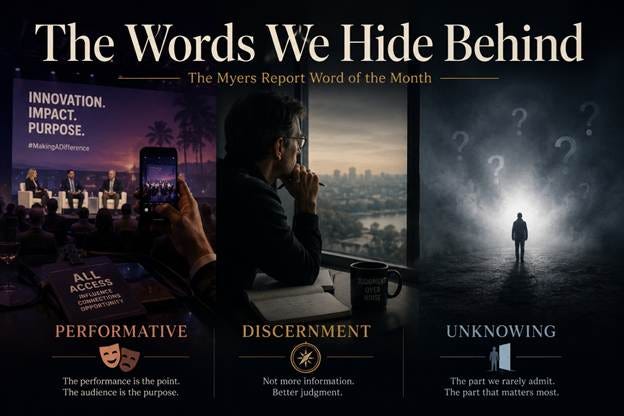
Every industry has a vocabulary of evasion. Words that arrive quietly, spread quickly, and suddenly appear in every keynote, in every Substack column, in new book subtitles, and in podcast interviews until you cannot attend a conference or scroll a LinkedIn feed without encountering them three times before coffee.
This is the inaugural edition of Myers Word of the Month, a new recurring feature in The Myers Report. The premise is simple: certain words migrate from near invisibility into sudden, omnipresent use. Each month, I will take one word apart and ask what its sudden ubiquity actually reveals about the moment we are in.
For the launch, I couldn’t choose just one. Three words have emerged more or less simultaneously, and they belong together. They are, in fact, three concepts merged into one generative trend.
Performative. Discernment. Unknowing.
The first names the condition. The second names what we claim as the cure. The third is what none of us will admit to in public, which makes it the most interesting and actionable of the three.
Performative has completed one of the more interesting journeys in recent intellectual history. It began in academic linguistics, where, according to ChatGPT, the philosopher J.L. Austin used it to describe speech acts that do things rather than merely say things — a judge pronouncing a verdict, a couple exchanging vows. Performative utterances are not true or false. They either work or they don’t.
Somewhere between Austin’s Oxford lectures and the current content economy, the word escaped its original context and inverted itself entirely. Now “performative” means the opposite of genuine. It means a gesture made for the audience rather than the cause. “Their sustainability commitment is performative.” “That apology was performative.” “The panel was performative.” “The LinkedIn photos from the stages at Cannes were performative.” Google searches for the word surged throughout 2025 to their highest levels on record. It is the adjective of our particular cultural moment. Merriam-Webster Dictionary (remember that?) defines performative as “made or done for show (as to bolster one's own image or make a positive impression on others).”
The word has found its most fertile ground in the great theater of professional life — the industry conferences, the flagship festivals, the invitation-only summits that populate the calendar of anyone operating at senior level. Cannes Lions. Davos. CES. SXSW. The Milken Institute Global Conference. These events are, by design, stages. The rosé at Cannes Lions is consumed as much for the photo as for the palate. The sessions are attended primarily for the hallway conversations that happen outside them. The awards exist largely to generate the case studies that will be used to win next year’s awards. The networking dinners are for the follow-up email that begins “great to connect last week.”
None of this is secret, and none of it is new. What is new, and what makes the word feel so electrically relevant right now, is the meta-layer: everyone now calls it performative, including while performing. Invoke the word with sufficient self-awareness and you are no longer complicit in the theater. You become a knowing participant, which is apparently a different and more respectable category. The conference circuit has fully mastered this move. It is now performative about its performativity, which is either a kind of cultural genius or a very elegant trap, depending on how long you have been following.
I have been following for a long time. I have sat on those panels, walked those floors, collected those lanyards, and flown home with the specific exhaustion of someone who has been performing attentiveness for three days straight. I know the genuine value embedded in these gatherings — the real conversations that happen at the edges, when the programming is done and people stop pitching each other and start actually talking. The conference that justifies the registration fee is never the one on the agenda. It is the one that happens around it.
Which is to say: the word names something real. That is why it spread.
Discernment is moving in the opposite direction: from the devotional into the executive suite. It spent decades in religious and spiritual contexts — Ignatian formation, pastoral leadership, the careful interior listening required to distinguish genuine signal from the noise of consensus and convenience. It was the vocabulary of retreat centers and seminary curricula, not strategy decks. (Ignatian formation refers to the process of developing the habits, awareness, and spiritual practices taught by Ignatius of Loyola that help a person make decisions with greater wisdom, self-awareness, and alignment with their deepest values and purpose.)
At its core, Ignatian formation is less about what decision to make and more about how to become the kind of person capable of making wise decisions.
Now it is appearing in AI presentations, C-suite development programs, and the keynote vocabulary of leaders who want to articulate, with some precision, why human judgment still matters in a world that can generate a thousand confident-sounding answers. The argument is not trivial: discernment is precisely what large language models cannot convincingly replicate. Judgment under genuine uncertainty, with incomplete information, where the cost of error is a real consequence rather than a hallucination — that remains stubbornly human territory. The market has reached for the word because the market has noticed the gap and needed something to name it.
At major industry gatherings, discernment is the event’s unofficial self-image. The curated agenda. The selective attendance. The practiced art of being in three conversations at once while appearing fully present in each. Speakers invoke it constantly — the ability to cut through noise, to know what matters, to see around corners. But most of what passes for discernment in these rooms is actually curation, which is a related but materially different skill. Curation means choosing among options that have already been pre-filtered and pre-approved. Discernment means sitting with difficulty long enough to arrive at a conclusion that was not on the original menu — and occasionally concluding that you cannot conclude anything yet.
That third word, the Third Brain word. is where the conference circuit, structurally, cannot follow.
Unknowing is the most interesting of the three precisely because it is essentially impossible to perform convincingly. You can fake confidence. You can perform vulnerability — and the thought leadership industrial complex has become quite accomplished at this, with its keynote confessions and carefully rehearsed “I used to believe X, until I realized Y” narrative arcs that every speaker’s coach now builds into the standard structure. Performed vulnerability is still performance. But genuine not-knowing has a quality that resists replication on a mainstage in front of an audience that paid to find out what is coming next.
The contemplative tradition has a text for this. The Cloud of Unknowing, written by an anonymous English mystic in the 14th century, argued that genuine encounter with what matters most can only occur in the deliberate absence of certainty — that the confidence you have accumulated must be released, not as failure, but as the precondition for real understanding. The secular version of this argument is now appearing quietly in serious thinking about AI epistemology, decision theory, and what it actually means to lead when the territory is changing faster than the maps. “Unknowing” requires a commitment to “unlearning,” letting go of legacy thinking.
Lessons for unknowing are not yet appearing on conference mainstages. The entire architecture of flagship industry events — the keynotes, the awards ceremonies, the invitation-only dinners, the activations organized by brands that want you to associate their logo with physical or intellectual vitality — is organized around the projection of forward momentum and earned certainty. But the speakers we’ll listen most closely to at the next conferences we attend will be those who admit: “I genuinely do not know what the next two years look like, my framework may be wrong, and the honest answer to your question is that the evidence is not yet sufficient to advise you with the confidence the question deserves.”
That person may not get re-booked. And yet that person is sharing a truth we must all confront.
Three words. One diagnosis.
The business community has developed remarkable fluency in naming its own pathologies. “Performative” is now deployed with precision by the very people performing. “Discernment” is invoked as a leadership capability without practicing it as a discipline. And “unknowing” — the most realistic posture available to anyone operating in a time of genuine uncertainty — is the word that never quite makes it onto the slide. It’s had an important place in my keynote comments for more than a year.
The gap between what we say at conferences and what we actually know is not a failure of intelligence. It is a structural feature of environments that reward confidence and penalize doubt. Understanding that gap, sitting with it long enough to learn something from it, is harder work than any panel discussion permits.
Those are the words for this month. Three of them. I will be back next month with one.
Jack Myers is a media ecologist, philosopher, and founder of The Myers Report and MediaVillage. He is the author of The Tao of Leadership and the forthcoming Your Third Brain: Powering a Future of Unimagined Possibilities (Morgan James Publishing). Word of the Month publishes the first week of each month. Responses, arguments, and suggested words are welcome.