

Why Artificial General Intelligence (AGI) Will Redefine Business Power, Leadership Advantage, and Human Value
AGI is not the next technology cycle. It is the first one that forces a reckoning with human value.

Every prior technology cycle amplified human capability while leaving the definition of human value largely intact. Industrial machines extended muscle. Digital systems extended memory. Networks extended reach. In each case, productivity increased, roles shifted, and new skills emerged, but human judgment, meaning-making, and authority remained central. AGI breaks that pattern
.When systems can reason, learn, and act across domains with speed and consistency that rivals or exceeds human cognition, intelligence itself ceases to be the primary source of economic or organizational value. What remains exposed is not a skills gap, but a values gap. Organizations are no longer compelled to ask how work gets done, but why it should be done at all, who bears responsibility for consequences, and what uniquely human capacities deserve protection and investment. AGI does not diminish humanity. It clarifies it.
For most of the last half-century, business has treated intelligence as a scarce resource.
Talent was limited. Insight was asymmetrical. Experience compounded slowly. Artificial General Intelligence (AGI) will end that era. Artificial General Intelligence will redefine business power, leadership advantage, and human value sooner than most organizations are prepared for.
(As developed fully in my upcoming book Your Third Brain, I refer to AGI as technointelligence, which incorporates technointuition and is more commonly recognized as co-intelligence between humans and machines. I use technointelligence because the word “artificial” is misleading and mis-represents intelligence that is greater than human capability. As this report establishes, the qualities that will enable successful implementation and incorporation of AGI into systems will be those that remain uniquely human. AGI marks the end of intelligence as advantage. What comes next is the era of meaning, trust, and human choice.)
AGI is not simply “smarter AI.” It is a structural break in how intelligence is created, distributed, and applied. When intelligence becomes non-scarce, competitive advantage shifts away from information and optimization toward judgment, purpose, trust, and human coordination.
This report forecasts the trajectory of AGI, its likely timelines, and its implications for business leaders who must operate through uncertainty without waiting for perfect clarity.
Shrinking Timelines to Artificial General Intelligence (Technointelligence)
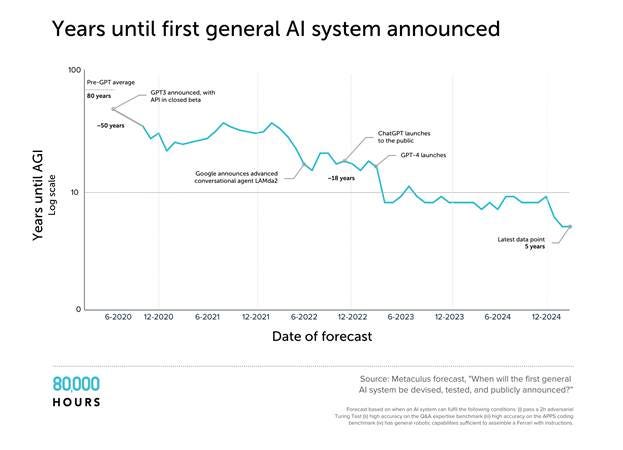
This chart illustrates how expert forecasts for the arrival of the first publicly announced Artificial General Intelligence (AGI) system have compressed dramatically over time. Based on aggregated predictions tracked by Metaculus and visualized by 80,000 Hours, the y-axis shows the number of years remaining until AGI, plotted on a logarithmic scale, while the x-axis shows the date of each forecast.
Before the emergence of modern large language models, forecasts commonly placed AGI 50 to 80 years away. With the announcement of GPT-3 in 2020, timelines began to shorten. Each subsequent milestone—Google’s LaMDA, the public launch of ChatGPT, and the release of GPT-4—corresponds with a sharp downward revision in expected timelines.
By late 2024, the median forecast converges around approximately five years, reflecting a growing consensus that AGI is no longer a distant, theoretical possibility but a near-term development. The key insight is not precision but direction: as capabilities become visible, expert expectations consistently move closer, not farther away. Our timeline is more immediate.
AGI Timelines Through 2030
If extended through 2026, this forecast curve would likely flatten rather than continue its steep decline. Early downward shifts reflected discovery as new capabilities surprised experts. By contrast, 2025–2026 marks a transition from surprise to implementation. Generative AI systems already exhibit cross-domain reasoning, autonomous agents, and persistent memory, all functional precursors to AGI. As uncertainty narrows, expert forecasts converge around a stable near-term window, most plausibly 2027–2028, for formal AGI announcement and wide implementation.
Importantly, limited implementation of AGI is preceding public declaration. In 2026, many enterprises are deploying AGI-like systems in practice without using the term. The timeline no longer measures arrival. It measures public readiness.
What AGI Actually Means for Business
AGI refers to systems capable of general learning and reasoning across domains, with the ability to adapt to new problems without task-specific retraining.
For business, this means:
Intelligence is no longer embedded in roles, hierarchies, or departments
Strategy becomes dynamic rather than periodic
Execution accelerates beyond human-only coordination limits
Knowledge work becomes collaborative with machines by default
AGI does not replace people. It repositions people. The organizations that fail will not be those that adopt AGI too slowly. They will be those that misunderstand what it displaces.
From Signals to Strategy
What you have read so far outlines why Artificial General Intelligence represents a structural break for business and leadership. What follows is not speculation or futurism theater. It is a forward-looking framework grounded in observable signals across research labs, capital flows, enterprise adoption, and human behavior inside organizations already feeling the pressure of co-intelligence.
The next section moves beyond headlines to examine how AGI is likely to emerge in practice, the stages leaders will encounter, and the decisions that will quietly determine who thrives and who becomes obsolete. This is where pattern recognition replaces prediction, and where leadership judgment matters more than technical fluency.
The analysis below is available exclusively to Myers Report subscribers.
Contents – Subscribers-Only Myers Report
What Most Forecasts Get Wrong About AGI
Why the AGI Transition Will Feel Uneven and Unfair
What Subscribers Should Watch Closely (2026–2027)
Why Leadership, Not Technology, Is the Constraint
What Comes Next: The Coming Phases of AGI Development
What AGI Changes Inside the Enterprise
The New Scarcity: Human Capacities
The Real Risk Is Not AGI. It Is Misalignment
The Myers Report Forecast
Final Perspective
Subscribers to The Myers Report receive trusted, forward-looking intelligence that goes beyond headlines to reveal the strategic, cultural, and human implications leaders must understand before markets shift. If this report resonates, share it with colleagues and leadership teams who need clear perspective now, and invite them to subscribe to stay ahead of what comes next.